
Where Should a Company Actually Start With AI?
How business leaders can choose the right first opportunity and learn from the results.
Many companies are already experimenting with AI. Employees are trying new tools, vendors are introducing new capabilities, and leaders are hearing a steady stream of ideas on how AI might help.
The harder question is where the company should focus first. A long list of possible use cases can create more activity without giving leadership much evidence of what is improving.
A better starting point is a business problem worth solving and the workflow behind it. That gives the organization something specific to examine, improve, and measure before making larger technology or investment decisions.
Bottom line
A company should usually start with a business workflow that matters, occurs frequently enough to improve, is well understood enough to change, carries manageable risk, and produces an outcome that can be measured.
Instead of asking, “Which AI tool should we use?” ask where work is taking too long, causing rework, producing inconsistent results, or limiting capacity.
What Does It Mean to Start With AI?
Starting with AI does not have to mean selecting a platform or launching a company-wide initiative. It can begin with a single business problem where AI may help people work differently or perform better.
It also helps distinguish between a use case and a workflow. A use case describes a specific application of AI. A workflow includes the people, information, decisions, handoffs, review steps, and outputs required to complete the work. Examining the workflow makes it easier to see where AI may help and what else may need to change.
Five Practical Filters for Choosing Where to Start
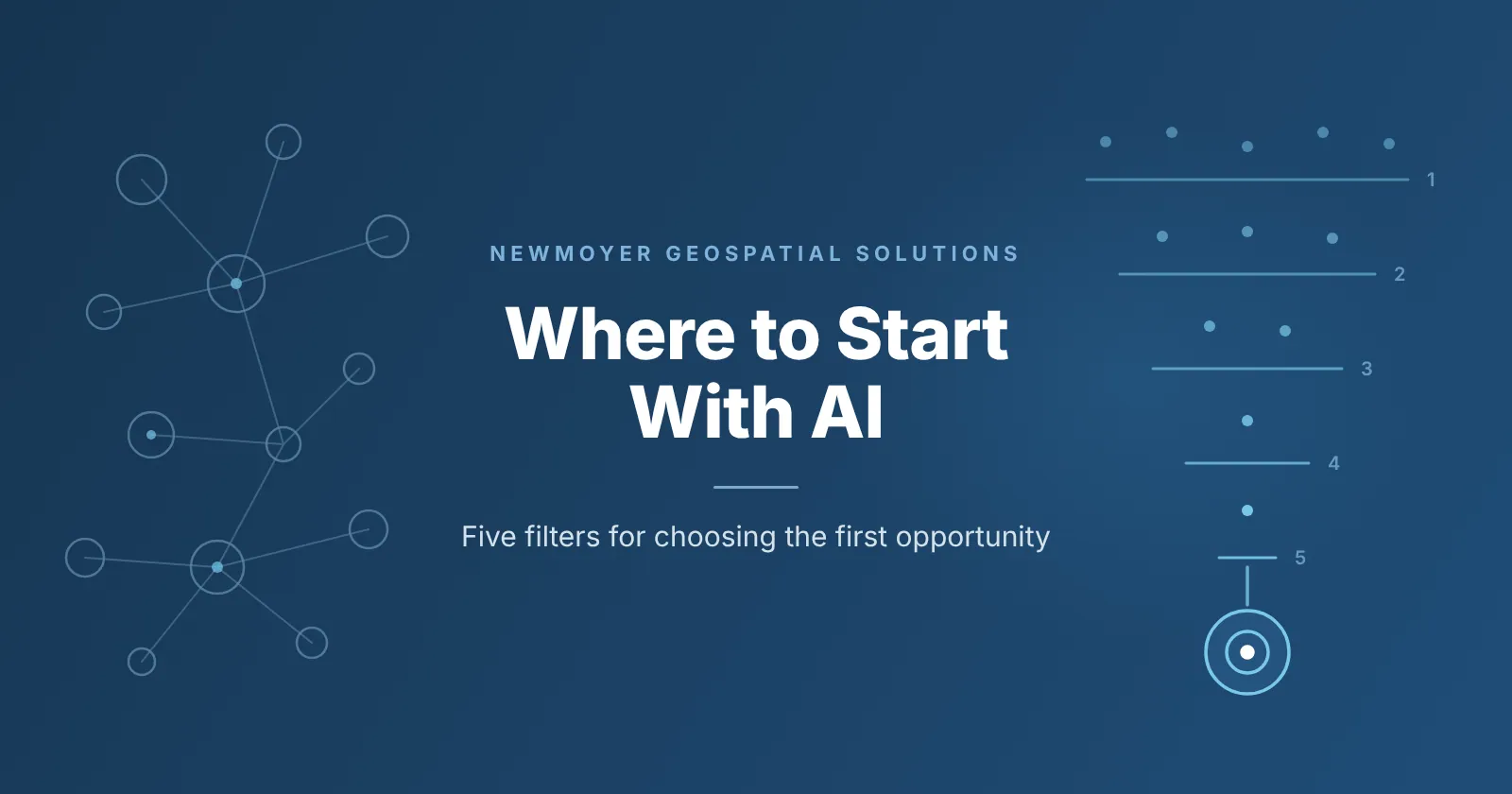
There is no single first AI use case that makes sense for every company. These five filters can help leaders narrow their options.
1. Business value
Would improving this work matter to the business? A good candidate aligns with an outcome leadership already cares about, such as faster turnaround, greater capacity, fewer revisions, better consistency, or stronger customer responsiveness.
If the improvement would have little effect on the organization, it may be interesting but not important.
2. Repeatability
Does the work occur often enough for improvement to matter? Repeated work gives the organization more opportunities to test the approach, compare results, and improve the process.
Recurring reports, proposals, meeting follow-up, document review, research, and customer communication are examples of workflows that may be worth examining, depending on the business.
3. Readiness
Can the organization explain how the work is done today? The process does not need to be perfect, but the people involved should understand the key inputs, decisions, handoffs, review points, and outputs.
This often reveals problems that AI alone cannot solve, such as unclear ownership, inconsistent information, or weak process standards.
4. Manageable risk
Can the organization pursue the opportunity responsibly? Leaders should consider the information involved, security and permission requirements, accuracy expectations, customer impact, and where human judgment is still necessary.
Some workflows can be tested within defined boundaries. Others may require additional safeguards, technical controls, or specialist review before moving forward.
5. Measurability
Will leadership know whether the change helped? The right measure depends on the workflow and may include time required, turnaround time, throughput, revisions, errors, quality, or adoption.
The goal is not to create a complicated measurement system. It is to gather enough evidence to decide whether to continue, adjust, expand, or stop.
What This Looks Like in Practice
Consider a company whose managers spend significant time preparing a recurring client report. The obvious AI question is whether generative AI can draft it faster.
A better approach is to examine the full workflow. Where is information coming from? What causes delays? Which steps require judgment? Where do revisions occur? What information can an AI system appropriately access, and where should human review remain?
Now, leadership has a defined problem, a workflow to improve, and measures such as preparation time, turnaround, revisions, and quality. The effort becomes a business test rather than a technology demonstration.
Let the Business Problem Determine the Technology Path
Once the business problem and workflow are clear, the technology discussion becomes more focused. Some opportunities may be addressed using the company’s existing capabilities. Others may require automation, systems integration, access to internal information, custom development, or stronger technical controls.
In some cases, AI may not be the best solution. The analysis may instead point to process redesign, traditional automation, better data, or clearer ownership. That is still a useful outcome because the objective is to improve the business, not to force AI into every problem.
A practical AI journey typically progresses through five stages: Explore, Plan, Prove, Transform, and Scale. The appropriate path depends on the organization’s business problem, readiness, complexity, risk, and available evidence.
How NGS AI Advisory Helps
NGS AI Advisory helps organizations identify where AI can deliver practical business value and determine a responsible path forward. That can include examining business priorities, evaluating workflows and potential use cases, considering risk and governance requirements, and defining how results should be measured.
When deeper implementation is required, NGS can also provide technical capabilities in systems integration, automation, custom development, hosting, and managed services.
Frequently Asked Questions
Should a company start with the easiest AI use case?
Not necessarily. Ease can simplify an experiment, but it does not make the work valuable. A stronger starting point combines business importance with reasonable readiness, manageable risk, and a clear way to measure improvement.
Should we choose an AI platform first?
Usually, the business problem should come first. Once the workflow and requirements are clear, leaders have a better basis for deciding which technology to use.
Does the workflow need to be fully standardized before adding AI?
No. It should be understood well enough to identify how the work is done, where problems occur, who is responsible, where review is required, and what improvement would look like.
Final Takeaway
Companies do not need to identify every possible AI opportunity before they begin. They need to choose one business problem carefully enough to learn something useful from the effort.
Look for work that matters, occurs regularly, is well understood enough to improve, can be pursued responsibly, and gives leadership something meaningful to measure. Then use the evidence to decide what deserves further investment.
Put AI to work. Maximize the benefits. Minimize the potential harms.
If your organization is deciding where AI should go to work first, NGS offers a 30-Minute AI Transformation Conversation to start that discussion.