
Your AI Roadmap Should Force Decisions
If everything is a priority, you have a list, not a roadmap.
AI ideas are easy to find. One team sees an opportunity for automation. Another wants an AI assistant. Someone is exploring agents. Employees are experimenting with tools, while vendors continue to introduce new capabilities.
The problem arises when every reasonable idea makes it onto the roadmap. Leadership ends up with a collection of opportunities but little direction on what deserves attention first.
A useful AI roadmap should force decisions. It should make clear what happens now, what is waiting, what must be true before an initiative moves forward, and what evidence will justify the next investment.
Bottom line
An AI roadmap should help leadership make decisions about where to focus limited attention, people, budget, and technical resources.
It should identify which opportunities deserve immediate action, which should wait, which dependencies require attention, who owns the work, and what evidence will determine whether an initiative continues, changes, expands, or stops.
A list tells you what you could do. A roadmap tells you what should happen next and why it should happen.
What Is an AI Roadmap?
An AI roadmap is a prioritized sequence of initiatives and decisions that guide an organization toward specific business outcomes.
The word “prioritized” matters. If every idea carries the same urgency, the roadmap has done little to help leadership decide where to invest.
A useful roadmap should also evolve as the organization learns. An initiative may advance, retreat, change direction, or be removed from the roadmap as new evidence becomes available.
Four Decisions an AI Roadmap Should Force
A practical roadmap should help leadership answer four key questions.
1. What Deserves Attention Now?
The first decision is which opportunities are important enough and ready to pursue.
A strong candidate addresses a meaningful business problem, involves a workflow the organization understands, carries manageable risk, and yields an outcome that leadership can evaluate. The goal is to choose deliberately rather than spread attention across every promising idea.
The first initiative need not be the easiest. It should have a clear reason for being first.
2. What Has to Wait?
Some good ideas belong later in the transformation process.
An initiative may depend on better data, clearer ownership, stronger governance, system access, process changes, employee capability, integration work, or evidence from an earlier effort. These dependencies do not diminish the opportunity’s value. They may simply mean the organization has work to do before it is ready.
A good AI roadmap should create focus by saying “later” almost as often as it says “now.”
That is where prioritization becomes real. Leaders often choose among several reasonable opportunities that cannot all receive the same level of attention at once.
3. What Has to Be True Before We Move Forward?
The roadmap becomes more useful when leadership defines what must occur before an initiative advances.
One opportunity may require access to reliable internal information. Another may need a defined review process or clearer security controls. A more complex initiative may depend on systems integration or on evidence that an earlier workflow has generated sufficient value to justify additional investment.
These conditions make dependencies visible and prevent momentum from alone driving the next decision. Leadership can see whether progress depends on technology, process, governance, employee enablement, or additional proof.
4. What Evidence Earns the Next Investment?
Every meaningful AI initiative should eventually reach a decision point.
Leadership should know what evidence would justify continuing, adjusting, expanding, or stopping the work. The measures should align with the business problem and may include turnaround time, capacity, quality, rework, adoption, customer outcomes, or another credible measure of improvement.
A pilot should never become a rollout simply because the technology worked. The next investment should be earned by evidence that the work improved meaningfully.
What This Looks Like in Practice
Consider a company evaluating five opportunities: AI-assisted proposal development, customer service support, internal knowledge search, workflow automation, and an AI agent connected to operational systems.
All five may be worth exploring, but that does not mean they should all begin at once.
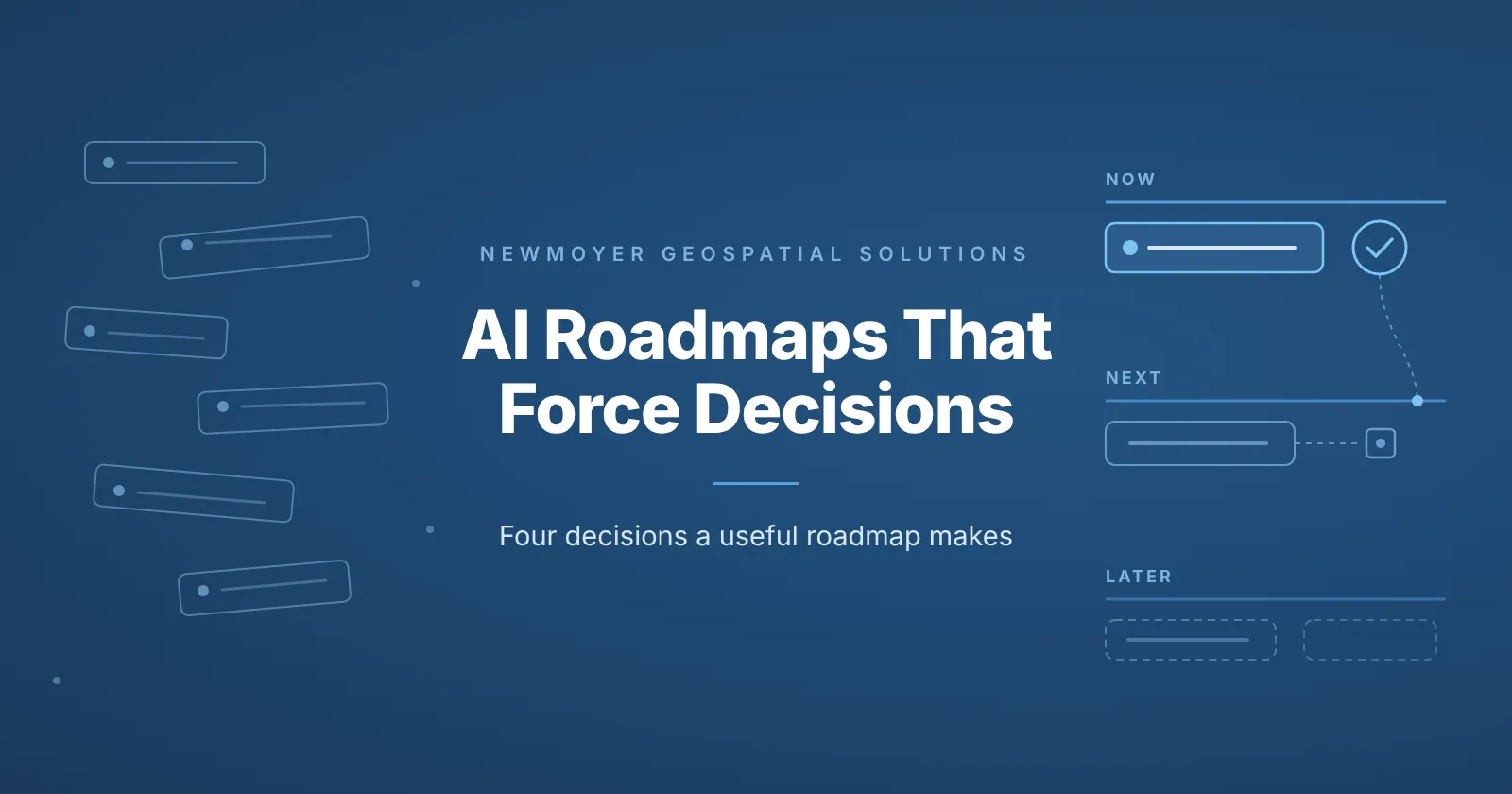
Proposal development might move into Now because the workflow is understood, the risk is manageable, and the outcome is measurable. An internal knowledge search may belong in Next because information quality and access rules require attention first. An AI agent connected to operational systems may sit in Later because it introduces additional integration, permission, monitoring, and operational requirements.
The roadmap has not ruled out the later opportunities. It has established what needs to happen before the organization is ready to pursue them responsibly.
That is more useful than launching five pilots and hoping priorities will sort themselves out.
Review the Roadmap as Evidence Changes
An AI roadmap should remain aligned with active leadership decisions.
As initiatives progress, leaders should ask what has changed. Has the workflow improved? Has the team uncovered a new dependency? Has the risk changed? Is another opportunity now better positioned to move forward?
The roadmap should change when the evidence changes. That is how planning stays connected to what the organization is learning.
How NGS AI Advisory Helps
NGS AI Advisory helps organizations turn AI opportunities into a practical sequence of business decisions. That can include clarifying priorities, evaluating workflows and use cases, identifying dependencies, establishing responsible-use requirements, assigning ownership, and defining the evidence leadership will use to make the next decision.
As the roadmap advances to deeper implementation, NGS can also support systems integration, automation, custom development, hosting, and managed services. This creates a path from deciding what deserves attention to implementing and supporting the work when the business case and evidence justify it.
Frequently Asked Questions
Does every company need a formal AI roadmap?
No. An organization can start with a clearly defined business problem and a focused opportunity. A roadmap becomes more useful as the number of opportunities, dependencies, teams, and investment decisions increases.
How far ahead should an AI roadmap extend?
Far enough to show direction and key dependencies while remaining flexible as the organization learns. Near-term work can be more specific, while later initiatives can remain conditional.
Should an AI roadmap specify specific technologies?
Sometimes, but the technology decision should align with the requirements of the work. Clarifying the business problem, workflow, dependencies, risk, and desired outcome gives leadership a stronger basis for deciding which technology is appropriate.
How often should leadership review the roadmap?
Review it when new evidence could shift priorities or investment decisions. The right cadence depends on the organization and the pace of its initiatives, but the roadmap should remain tied to active decisions rather than becoming an annual planning document.
Final Takeaway
A good AI roadmap creates focus. It helps leadership decide what to do now, what to put on hold, what must be true before moving forward, and what evidence will earn the next investment.
The value of the roadmap is not the number of initiatives it contains. Its value lies in the quality of the decisions it helps leadership make.
Put AI to work. Maximize the benefits. Minimize the potential harms.
If your organization has more AI opportunities than clarity on what should happen next, NGS offers a 30-Minute AI Transformation Conversation to start the discussion.