
Prompts, Workflows and AI Agents: What Leaders Need to Know
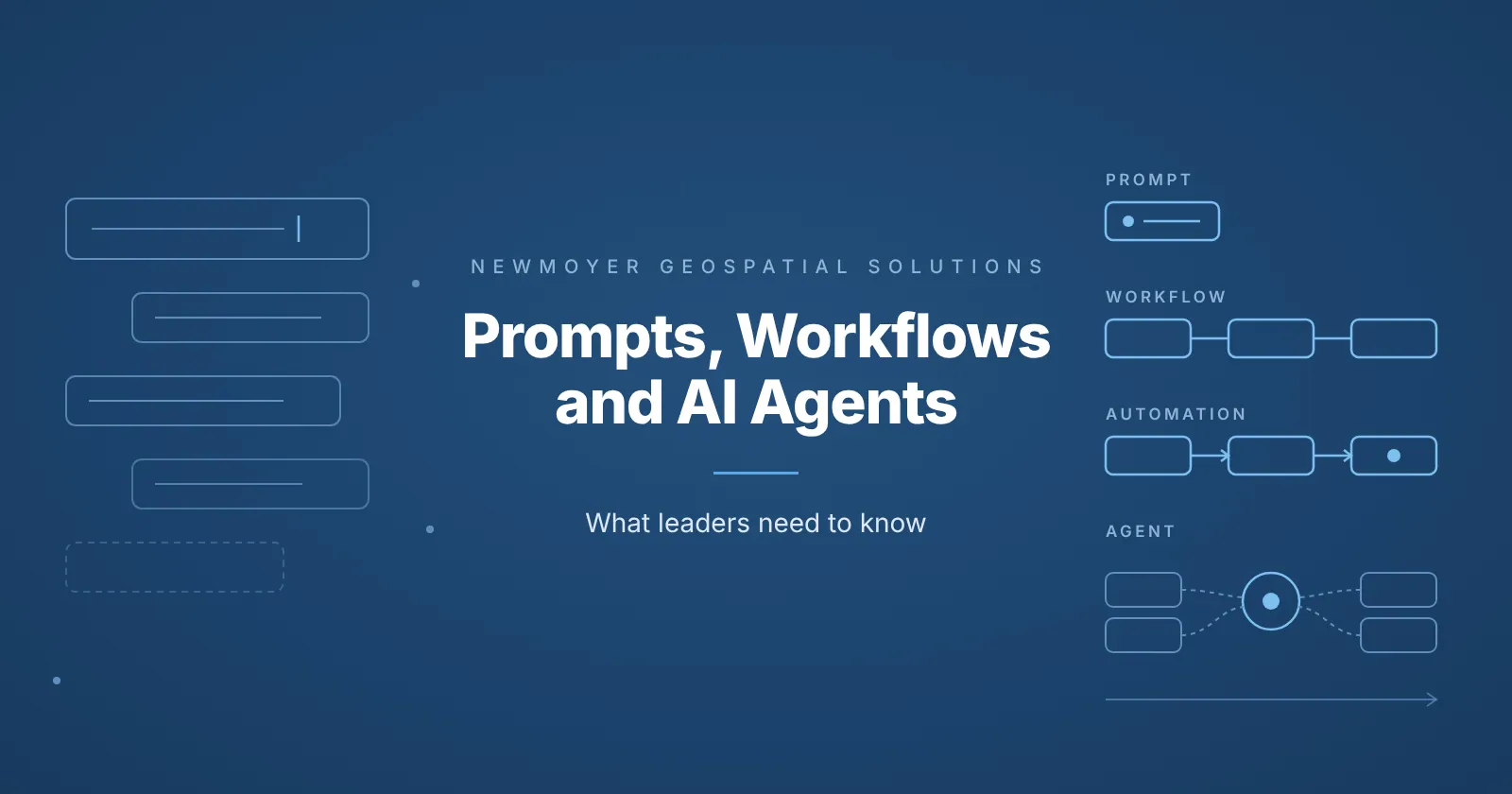
How AI moves from individual tasks to workflows, automation, and agents
AI conversations can move quickly from prompts to workflows, automation, and agents. That can make it sound as though every company should be moving toward increasingly advanced AI. A prompt may be enough to improve a single task, while a workflow can make AI use more repeatable. Automation can remove manual steps, and an agent may take on several actions across a process.
The problem is assuming that more advanced automatically means better. Each level can create value, but each also changes what the organization needs to manage. The leadership question is simple: How much of this work should AI handle, and what needs to be true before we give it more responsibility?
Bottom Line
Prompts, workflows, automation, and agents are different ways to integrate AI into work. As AI takes on more of a process role, leaders need greater clarity on ownership, data access, human review, safeguards, escalation, and measurement.
The goal is not to reach agents. The goal is to improve the work. The appropriate level of AI depends on the business problem, the workflow, the risks involved, and the value the organization expects to create.
Four Levels of AI Integration
These levels are not a maturity ladder every company needs to climb. They represent different operating choices, and each requires a different level of discipline in the work.
- 1PromptHelps with a task
- 2WorkflowCreates a repeatable process
- 3AutomationExecutes defined steps
- 4AgentTakes actions toward a goal
Increasing integrationIncreasing responsibility
The goal is not to get to agents. The goal is to improve the work.
1. Prompt: AI Helps With a Task
At the prompt level, a person asks AI to help with a specific task. That might include drafting an email, summarizing a document, organizing notes, or reviewing information. The employee provides the instructions, evaluates the response, and owns the final result.
A good prompt can improve an individual task, but it does not, by itself, create a repeatable business process. The value depends heavily on the person using the tool, the quality of the input, and the judgment applied to the output.
2. Workflow: AI Becomes Part of How the Work Gets Done
A workflow defines where AI fits within a repeatable process. The organization decides when to use AI, what information it receives, what it produces, where human review occurs, and what happens next. Rather than relying on each employee to invent a different approach, the team has a more consistent way of working.
At this level, the questions shift. Leaders need to know who owns the workflow, where judgment still matters, what information AI can use, and how the organization will know whether the new process is better. The value lies in making the work more consistent and repeatable.
3. Automation: Steps Begin Happening Automatically
Automation removes the need for someone to manually initiate or move each step. A new inquiry might trigger classification and routing, approved information may move between systems, or a completed step may automatically start another.
This can reduce manual effort, but the process must be clearly defined first. Automating a poorly defined process can simply move the problem faster. Leaders need to understand what triggers the automation, which systems and data are involved, how exceptions are handled, and who is responsible for monitoring the process.
4. Agent: AI Takes On More of the Process
An AI agent can be designed to pursue a defined goal across multiple steps, use approved tools or information, and take actions within established boundaries. This introduces a different level of responsibility because the system may act across a process rather than simply assisting with one task.
An agent may need access to internal systems, business information, or other tools. Leaders need to define what it can do, what requires approval, when a person must intervene, and how its activity will be monitored. Greater autonomy requires greater clarity, not less.
The further AI moves from assisting with a task to acting across a process, the more important ownership, permissions, safeguards, monitoring, and escalation become.
What This Looks Like in Practice
Consider proposal development. An employee might begin by using a prompt to draft a proposal from discovery notes. A defined workflow could standardize how those notes, approved company information, review, and final approval are integrated.
Automation might move information between systems or trigger the next step when the proposal reaches a defined stage. An agent could coordinate several parts of the process within established permissions. Each step adds capability, but it also adds complexity and oversight.
The question is whether that additional integration provides enough improvement to justify what comes with it.
Measure the Work, Not the Sophistication
A company using well-designed prompts within a disciplined workflow may create more business value than one deploying agents into a poorly understood process. Measurement should follow the business problem, not the technology's sophistication.
Depending on the workflow, leaders may consider turnaround time, rework, consistency, quality, capacity, human-review effort, adoption, or another meaningful outcome. The most advanced solution is not automatically the best. The right solution is the one that improves the work at an appropriate level of cost, complexity, and risk.
How NGS AI Advisory Helps
NGS AI Advisory helps organizations determine where AI can deliver practical business value and what level of AI integration is appropriate for the work. That can include identifying workflows worth improving, mapping the current process, evaluating opportunities for AI assistance or automation, defining ownership and human review, establishing responsible-use safeguards, and deciding what evidence should guide the next move.
When deeper implementation is justified, NGS can also support systems integration, automation, custom development, hosting, and managed services. This aligns the business decision with the technical capability required to support it.
Frequently Asked Questions
What is the difference between a prompt and an AI workflow?
A prompt provides AI with instructions for a specific task. An AI workflow outlines how AI fits into a repeatable business process, including inputs, outputs, review points, ownership, and next steps.
What is the difference between automation and an AI agent?
Automation typically follows defined rules or triggers to perform specific actions. An AI agent can be designed to pursue a goal across multiple steps and make limited decisions within defined permissions.
Do all companies need AI agents?
No. Many business problems can be addressed with prompts, improved workflows, or automation. Agents make sense when the additional autonomy generates enough value to justify the added complexity and oversight.
How should leaders decide how much responsibility to assign to AI?
Start with the business process. Understand the work, the information involved, the risks, and the desired outcome. Then decide where AI should assist, what can be automated, where human judgment is still necessary, and what evidence will determine whether the approach should be expanded.
Final Takeaway
AI adoption should not become a race from prompts to agents. Leaders should decide how AI fits into the work, how much responsibility it should assume, and what controls are needed at each level. Sometimes the right answer is a better prompt. Sometimes it is a standardized workflow, automation, or an agent.
Start with the business process. Choose the level of AI that improves the work responsibly. Then build the operating discipline around it.
Put AI to work. Maximize the benefits. Minimize the potential harms.
If your organization is deciding where AI should fit into the work and how far to go, NGS offers a 30-Minute AI Transformation Conversation to start the discussion.