
Not Every Problem Needs AI: How Leaders Decide Where AI Belongs
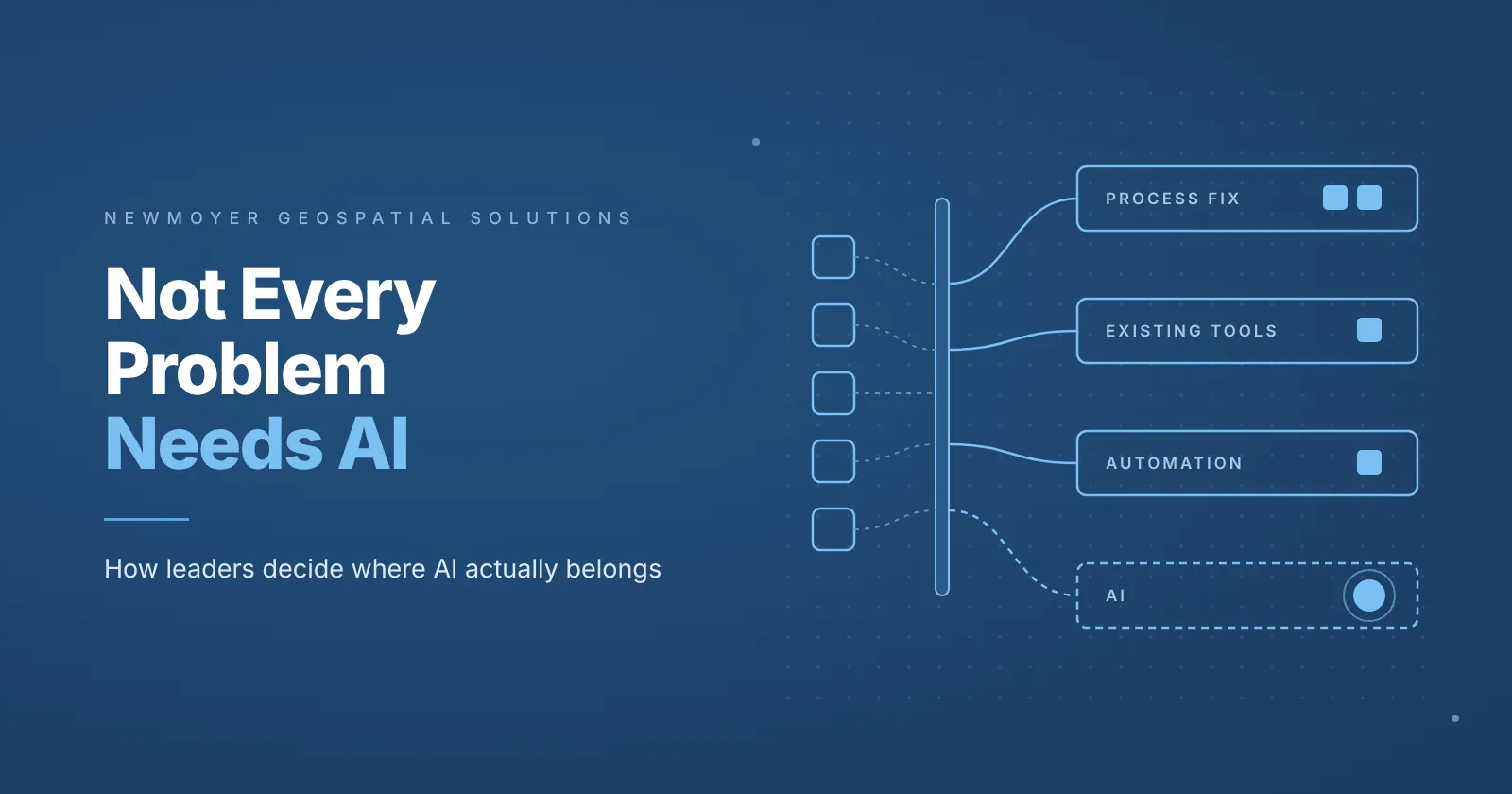
How to distinguish meaningful AI opportunities from problems better solved another way
Once a company decides AI is a priority, almost every problem can start to look like an AI problem. A slow process needs an agent. A reporting issue becomes a generative AI project. A broken handoff becomes an automation initiative.
Sometimes those are the right answers. Sometimes the organization is about to spend time and money on AI to solve the wrong problem. The leadership discipline is knowing the difference.
The question should not be, “Can AI do this?” The better question is, “Is AI the best way to improve this work?”
Bottom Line
A good AI use case starts with a meaningful business problem, but a business problem does not automatically require an AI solution. Leaders should first understand the root cause of the problem, then determine whether AI offers something that process improvement, existing technology, systems integration, or conventional automation cannot provide as effectively.
The objective is to solve the problem using an approach that delivers practical business value at an appropriate level of cost, complexity, and risk. AI is an option, not the objective.
Four Questions to Ask Before Calling It an AI Use Case
Before prioritizing an AI opportunity, leadership should first determine whether the problem is even an AI use case. Four questions can help make that decision.
1. What Problem Are We Trying to Solve?
Start with the work rather than the proposed technology. “We need an AI agent” suggests a possible solution but says very little about the business problem.
A more useful starting point might be that customer requests take too long to route, employees spend hours compiling information for reports, or teams issue inconsistent responses to similar situations. Leadership should be able to describe what is happening today, why it matters, and what improvement would look like before deciding which technology belongs in the solution.
The clearer the problem, the easier it is to evaluate the options.
2. What Is Causing the Problem?
A slow or inconsistent workflow can have many causes. The issue may stem from duplicate steps, poor data, unclear ownership, missing system connections, inconsistent standards, or excessive manual review.
Those problems may call for process redesign, better integration, clearer accountability, or conventional automation. Adding AI before understanding the root cause can make the solution more complicated without fixing what is actually wrong.
Other work may depend on interpreting unstructured information, generating or transforming language, identifying patterns across information, or supporting decisions that are difficult to express through fixed rules. These characteristics can make a stronger case for AI because the technology adds a capability the workflow genuinely needs.
3. Does AI Offer Advantages That Simpler Solutions Cannot?
Once the problem and its cause are clear, compare AI to the alternatives.
Could unnecessary steps be eliminated? Does the existing software already have the capability? Would a system integration eliminate the manual handoff? Could rules-based automation handle the task reliably? Would clearer standards or better training solve most of the problem?
AI becomes more compelling when it offers a meaningful advantage over those options. The decision should be based on the work required and the expected improvement, not on the novelty of the technology.
A use case is not strategic simply because AI is involved.
4. Can We Tell Whether the Work Improved?
Before moving forward, leadership should decide how it will determine whether the solution worked. The measure should align with the business problem rather than the technology.
Depending on the workflow, that could mean turnaround time, rework, consistency, capacity, access to information, quality, human-review effort, or another meaningful outcome. If the organization cannot define what “better” looks like, it will be difficult to determine whether the use case warrants further investment.
The same principle applies if the best solution turns out to be simpler than AI. The outcome that matters is improving the work.
What This Looks Like in Practice
Consider a company where employees spend too much time routing incoming customer requests. The first reaction might be to build an AI agent that reads each request and routes it to the appropriate team.
That could make sense, but the details matter. If every request falls into five predictable categories and customers already provide the required information through structured fields, simple routing automation may solve the problem with less complexity.
If requests arrive as long, inconsistent emails that require interpreting intent, extracting key details, and determining the appropriate next step, AI may add meaningful capability that fixed rules cannot provide as effectively.
The business problem remains the same. The nature of the work determines whether AI belongs in the solution.
Measure Business Value, Not AI Activity
Organizations do not need to maximize the number of AI use cases they pursue. They need to identify where AI delivers enough improvement to justify the investment, complexity, oversight, and risk involved.
That means evaluating business outcomes rather than counting tools, pilots, prompts, or agents. Leadership should be able to explain what improved, why the chosen approach was appropriate, and whether the evidence supports continuing or expanding the work.
Sometimes the strongest AI decision is to decide that AI is unnecessary.
How NGS AI Advisory Helps
NGS AI Advisory helps organizations evaluate business problems before committing to a technology solution. That can include clarifying the problem, mapping the current workflow, identifying root causes, comparing options for process improvement, automation, systems integration, and AI, and defining how success will be measured.
When AI is the appropriate solution, NGS can also help establish requirements for responsible use, human oversight, safeguards, and escalation paths. When deeper technical implementation is needed, NGS can support systems integration, automation, custom development, hosting, and managed services.
The goal is to apply AI where it creates practical value and use simpler approaches where they make more sense.
Frequently Asked Questions
How do you determine whether a business problem needs AI?
Start by understanding the problem and its root cause. AI may be appropriate when the work requires capabilities such as interpreting unstructured information, generating or transforming content, identifying patterns, or supporting decisions that are difficult to address with fixed rules.
When is traditional automation preferable to AI?
Traditional automation can be a better fit when the workflow is predictable and decisions can be captured by clear rules or triggers. In those situations, AI may add complexity without sufficient additional value.
Can improving the process eliminate the need for AI?
Yes. Some problems stem from unnecessary steps, unclear ownership, inconsistent standards, poor data, or missing system connections. Addressing these issues may improve the work without requiring AI.
What makes an AI use case worth pursuing?
A worthwhile AI use case addresses a meaningful business problem, offers an advantage over simpler alternatives, can be implemented responsibly, and yields an outcome the organization can evaluate.
Final Takeaway
The goal is not to find as many AI use cases as possible. It is to identify the problems where AI delivers meaningful business value and where the organization is prepared to use it responsibly.
Start with the problem. Understand what is causing it. Compare AI with simpler alternatives. Then choose the approach that improves the work at the right balance of cost, complexity, and risk.
Put AI to work. Maximize the benefits. Minimize the potential harms.
If your organization is evaluating where AI fits in the business and which opportunities are worth pursuing, NGS offers a 30-Minute AI Transformation Conversation to start the discussion.